What Is AIOps? Complete Beginner’s Guide for 2026
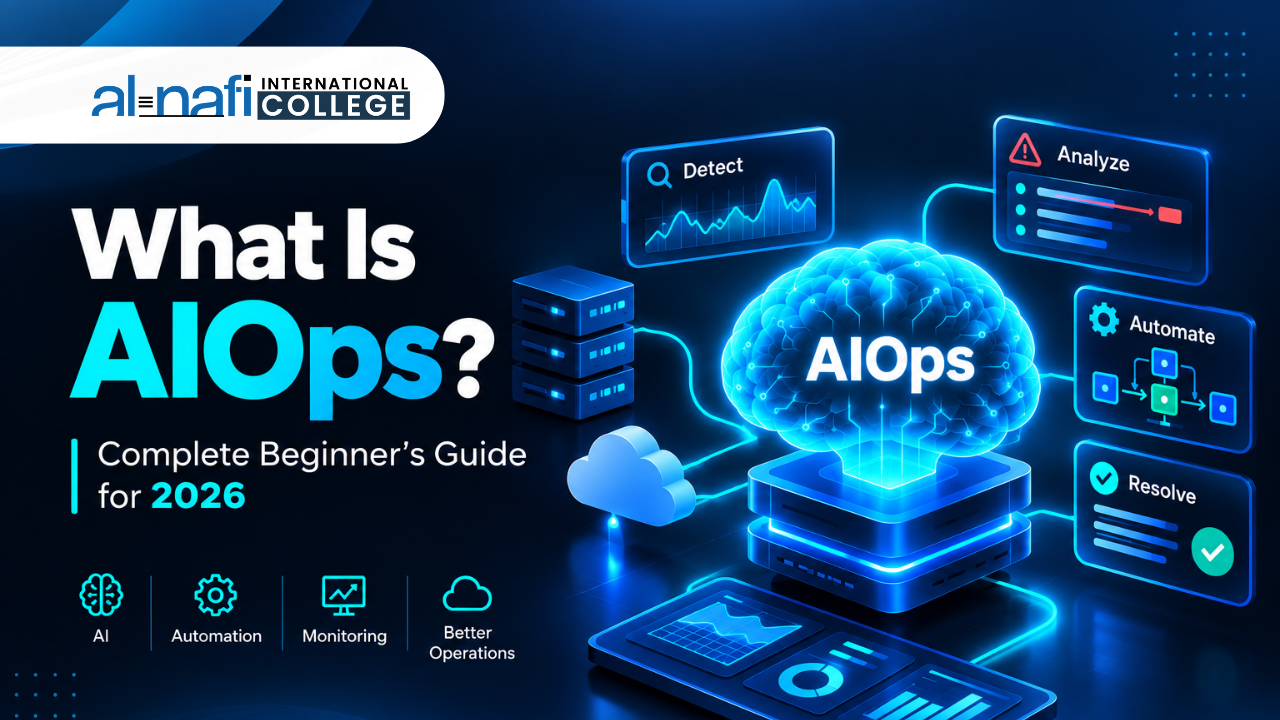
What Is AIOps? A Beginner's Guide for IT Pros in 2026
Last Updated: August 2026
It's 3 a.m. in Lahore, and a phone won't stop buzzing. Fifty alerts have fired in the last ten minutes across three monitoring dashboards, and nobody on the on-call team knows yet whether this is one real outage or fifty unrelated blips. That scene repeats itself nightly across data centers, banks, and telecom networks in Pakistan, and it's exactly the problem AIOps was built to solve.
If you've been asking what AIOps is and whether it's worth learning in 2026, the short version is this: it's the discipline of using artificial intelligence and machine learning to manage IT operations at a scale humans can no longer handle manually. This guide explains AIOps in plain terms, where it's already being used in Pakistan's IT sector, the skills you'll need, and where this specialization can take your career.
Table of Contents
The Alert Fatigue Problem Costing IT Teams Their Nights](#the-alert-fatigue-problem-costing-it-teams-their-nights
What Is AIOps? A Simple, Direct Definition](#what-is-aiops-a-simple-direct-definition
How AIOps Works: From Raw Logs to Automated Fixes](#how-aiops-works-from-raw-logs-to-automated-fixes
AIOps vs. Traditional Monitoring vs. DevOps](#aiops-vs-traditional-monitoring-vs-devops
AIOps Use Cases Already Running in Pakistan's IT Sector](#aiops-use-cases-already-running-in-pakistans-it-sector
AIOps Skills Required to Move From Reactive to Predictive IT](#aiops-skills-required-to-move-from-reactive-to-predictive-it
The AIOps Career Path: Where This Skill Set Takes You](#the-aiops-career-path-where-this-skill-set-takes-you
Your First 30 Days: A Learning Path](#your-first-30-days-a-learning-path
Frequently Asked Questions](#frequently-asked-questions
Where to Start
The Alert Fatigue Problem Costing IT Teams Their Nights
Most mid-to-large IT environments in Pakistan run a patchwork of monitoring tools: one for servers, one for network, one for applications, maybe another for cloud infrastructure. Each tool generates its own alerts, in its own format, with no shared context between them.
The result is what practitioners call alert fatigue. Engineers get so many notifications that they start ignoring low-priority ones, which is exactly how real incidents slip through. Mean time to resolve (MTTR) climbs, on-call staff burn out, and IT operations stay permanently reactive instead of getting ahead of problems.
Pakistan's IT and IT-enabled services exports crossed $3.2 billion in FY2024, according to State Bank of Pakistan data. That scale only holds up if uptime and SLA compliance stay consistent, which is precisely why alert overload has become a business risk, not just an engineering annoyance. This is a staffing and process problem as much as a technology one, and it's the gap AIOps is designed to close.
What Is AIOps? A Simple, Direct Definition
What Is AIOps in Plain English?
AIOps stands for Artificial Intelligence for IT Operations. It uses machine learning to automatically collect, correlate, and analyze the flood of data coming from servers, networks, applications, and cloud platforms, then flags real problems and, in mature setups, fixes routine ones without a human touching a keyboard.
Gartner, the research firm that coined the term in 2016, describes AIOps platforms as systems that combine big data and machine learning to automate IT operations processes, including event correlation, anomaly detection, and causality determination. Gartner also projected that by 2023, 40% of large enterprises would combine big data and machine learning capabilities to support or partially replace existing monitoring, service desk, and automation processes, up from roughly 5% in 2019. That trajectory is why AIOps literacy is turning into a baseline expectation for IT operations roles rather than a niche specialty, especially in environments running dozens of interconnected systems.
According to IBM, the goal isn't to replace IT teams but to filter noise so engineers spend their time on problems that actually need human judgment.
How AIOps Works: From Raw Logs to Automated Fixes
AIOps isn't one tool; it's a layered process that sits on top of your existing monitoring stack.
Data ingestion: the platform pulls logs, metrics, traces, and events from every connected source, whether that's a Kubernetes cluster, a firewall, or a legacy on-premises server.
Correlation: machine learning groups related alerts together. Fifty alerts about the same database outage become one incident instead of fifty separate tickets.
Anomaly detection: the system learns what "normal" looks like for your environment and flags deviations before they become outages, not after.
Root cause analysis: instead of an engineer manually tracing a problem through five systems, the platform points to the likely source.
Automated remediation: for known, repetitive issues, such as restarting a stuck service, the platform can act automatically, following pre-approved runbooks.
Tools like Splunk ITSI, Dynatrace, Datadog, BigPanda, and Moogsoft are commonly used across this workflow. Many organizations also connect AIOps insights into ServiceNow or PagerDuty so incidents route straight into existing ticketing and escalation processes.
A Simplified Look at Anomaly Detection Logic
You don't need a PhD to understand the core math behind anomaly detection. Most platforms are doing a more sophisticated version of this basic idea: flag any value that sits far outside the normal range.
```python import statistics
Sample response-time readings (ms) collected every minute
response_times = [120, 118, 125, 130, 122, 119, 340, 121, 124]
mean = statisticsmean(response_times) stdev = statistics.stdev(response_times)
A z-score above 2 is a common threshold for "worth investigating"
for reading in response_times: z_score = (reading - mean) / stdev if abs(z_score) > 2: print(f"Anomaly detected: {reading}ms (z-score: {z_score:.2f})") ```
Running this returns exactly one flagged reading: the 340ms spike buried in an otherwise stable pattern. Real AIOps platforms layer in seasonality, multiple metrics, and historical baselines, but the underlying question is the same one this script answers: does this look like everything else, or not?
AIOps vs. Traditional Monitoring vs. DevOps
People often conflate these three, but they solve different problems.
| Traditional Monitoring | DevOps | AIOps | |
|---|---|---|---|
| Focus | Monitoring individual tools and generating alerts | Faster and more reliable software delivery | Correlating operational data across multiple tools and systems |
| Human Effort | High manual effort for alert review and triage | Automation of build, testing, and deployment processes | Automated detection, correlation, and routine incident response |
| Best Fit | Small or straightforward IT environments | Software development and release workflows | Complex production environments with high volumes of alerts and operational data |
In short: DevOps changes how software gets built and shipped. AIOpschanges how the resulting systems get watched and fixed once they're live.
AIOps Use Cases Already Running in Pakistan's IT Sector
AIOps isn't a future concept for Pakistan's tech industry; it's already operating quietly in a few key places.
Banks running 24/7 digital banking platforms use AIOps-style correlation to catch transaction processing slowdowns before customers notice, since even short downtime on core banking systems carries real financial and reputational risk. Telecom operators managing dense network infrastructure lean on anomaly detection to spot cell tower or bandwidth issues faster than manual monitoring ever could.
Software houses and BPOs serving international clients under strict SLA agreements are adopting AIOps practices too, partly because Pakistan's IT export sector has grown into a genuine hub for outsourced infrastructure and support work, according to the Pakistan Software Export Board (PSEB). Clients based in the US, UK, and Gulf region expect uptime guarantees that manual monitoring struggles to meet consistently. E-commerce platforms handling seasonal traffic spikes, particularly around sales events, use the same predictive alerting to avoid checkout failures during peak load.
AIOps doesn't just make IT operations faster; it shifts the entire team's posture from reactive firefighting to predictive prevention.
AIOps Skills Required to Move From Reactive to Predictive IT
Employers looking for AIOps talent aren't asking for a single certification; they want a specific mix of operations and data skills.
Scripting and querying: Python and SQL for working with logs, metrics, and building automation.
Machine learning fundamentals: not deep research-level ML, but enough understanding of anomaly detection and classification models to interpret what a platform is telling you.
Cloud platforms: working knowledge of AWS, Azure, or Google Cloud, since most modern monitoring data lives in cloud-native environments.
Containers and orchestration: familiarity with Docker and Kubernetes, since most AIOps deployments monitor containerized workloads.
Monitoring and observability tools: hands-on comfort with platforms like Grafana, Kibana, Dynatrace, or Splunk.
ITSM process knowledge: understanding how incidents, problems, and changes flow through ServiceNow or similar systems, so automation actually fits existing workflows.
Engineers coming from a DevOps or SysOps background usually have a head start here, since AIOps builds directly on operational experience rather than replacing it.
The AIOps Career Path: Where This Skill Set Takes You
AIOps skills don't sit in one job title; they layer onto several existing IT operations roles and open new ones.
A typical path starts with a DevOps Engineer or System Administrator role, moves into a dedicated AIOps Engineer or Site Reliability Engineer (SRE) position once monitoring and automation skills deepen, and can progress toward a Platform Engineer or IT Operations Manager role overseeing automation strategy across an organization. Some professionals specialize further into AIOps Architect positions, designing how AI-driven monitoring integrates across an entire enterprise stack.
For working professionals already in DevOps or SysOps, adding AIOps skills is less of a career change and more of a natural upgrade, one that positions you for higher-responsibility roles as more organizations move toward automated, AI-assisted operations.
Your First 30 Days: A Learning Path
If you're starting from zero, here's a realistic sequence using free resources rather than a wall of documentation.
Week 1: Get the concepts straight. Read Gartner's public AIOps research summaries and IBM's AIOps explainer articles to understand the vocabulary before touching a tool.
Week 1-2: Build baseline Python skills. Work through freeCodeCamp's free "Scientific Computing with Python" or "Python for Everybody" modules, focused on reading and manipulating data.
Week 2: Learn to read a dashboard. Explore Grafana Play (play.grafana.org), a free public sandbox with real sample dashboards. No signup required.
Week 3: Get cloud fundamentals. Use AWS Skill Builder's free digital courses or Microsoft Learn's free Azure Fundamentals path to understand where monitoring data actually lives.
Week 3-4: Touch containers. Run Kubernetes basics through Killercoda's free interactive scenarios, no local install needed.
Week 4: Understand the incident workflow. Read PagerDuty's free incident response documentation to see how alerts turn into tickets and escalations in a real ITSM process.
By the end of the month, you won't be job-ready yet, but you'll understand every term in an AIOps job posting and know which piece to go deeper on first.
Frequently Asked Questions
Is AIOps the same as DevOps? No. DevOps is a set of practices for building and deploying software faster through collaboration and automation. AIOps focuses specifically on using AI and machine learning to manage IT operations, monitoring, and incident response. The two overlap and often work together, but they solve different problems in the software lifecycle.
Do I need a data science background to learn AIOps?
Not necessarily. Most AIOps roles build on IT operations skills, so experience with scripting, cloud platforms, monitoring, and infrastructure is often more important than advanced statistics or data science.
What industries in Pakistan are hiring for AIOps skills?
Banking and fintech, telecom, e-commerce, and software export companies serving international clients are the most active adopters right now. These sectors operate systems where downtime has a direct, measurable business cost, which makes automated monitoring a budget priority rather than a nice-to-have.
Can a SysOps or network engineer switch into an AIOps role?
Yes. Professionals with strong systems administration or network operations backgrounds already understand the infrastructure AIOps monitors day to day. Adding cloud platforms, scripting, and machine learning fundamentals on top of that existing experience is a realistic, achievable path rather than a full career restart.
Which tools should a beginner learn first for AIOps?
Start with a monitoring and observability tool like Grafana or Splunk to understand how data gets visualized, then add Python for scripting and basic exposure to a cloud platform like AWS or Azure. From there, layer in AIOps-specific platforms like Dynatrace or ServiceNow AIOps.
Does AIOps replace on-call engineers?
No. AIOps reduces the volume of noise engineers have to sift through and automates routine fixes, but human judgment is still required for novel incidents, business context, and decisions with real consequences. Most teams describe it as removing the busywork, not the job.
Is AIOps only useful for large enterprises?
Large, complex environments see the biggest gains because they generate the most alert noise, but mid-sized companies running multiple cloud services and customer-facing platforms are adopting AIOps practices too, particularly software houses managing several client environments at once.
Where to Start
Reading about AIOpsand actually building the skills to work with it are two very different things, and the gap between them is usually hands-on practice with real tools and real infrastructure. The 30-day path above will get you conversational in the concepts. If you're serious about turning that into a career move, structured training makes the difference between knowing the terms and being able to apply them under pressure.
Al Nafi International College offers career-focused training in AIOps, DevOps, and SysOps designed to build job-ready skills through hands-on labs rather than theory alone. You'll work with real monitoring, automation, and cloud tools instead of just reading about them, and get career support to help translate that skill set into your next role. Explore the AIOps program at Al Nafi International College to see the curriculum, lab structure, and career support included.
Start Learning Today.
Powered by Froala Editor